- Droughts in southern Africa (e.g. Malawi, South Africa, etc.).
- Dry conditions & wild fires in Indonesia, Malaysia, etc.
- Dry conditions & wild fires in the Amazon region.
- El Nino years, and especially the year after an El Nino year, are generally hotter on a global scale - so expect 2027 to be anothe record year.
Saturday, October 17, 2026
The 2026/2027 'Super' El Nino
Fact: the current SSTs in the eastern tropical Pacific are about 3 deg C higher than normal and that's more than 1 deg C warmer than the powerful 1997 & 2015 El Ninos. So, what can we expect?

Sealevel Rise & Lower
This one is actually pretty cool: https://slidingshores.com/
Now, the amount of rise & lower is getting pretty crazy & is way more than anything that could happen on Earth, but a) it's fun and b) this is the only 'animation' that I know of where you can actually lower sealevel to demonstrate conditions say during the LGM.
For a more 'realistic' sea level rise visualization: consider the Coastal Risk Finder.
Thursday, October 15, 2026
AI & UHI
We all know the connection between AI, energy use, and global warming. But there is another angle: local heating, in-essence a version of the well-understood UHI. More here:
The Map Animator
This is awesome: https://mapanimator.baldinger.se/
Draw your route or drop in a GPX file, add signs and a camera move, and download it as an MP4 video, up to 4K, ready for your editor.
Tuesday, October 6, 2026
How To Sound Smart When Talking About Charts
How To Sound Smart When Talking About Charts is a fun little compilation of quotes with comments and context.
Thursday, October 1, 2026
El Nino Impacts
Very cool interactive visual from The Climate Brink: https://dashboard.theclimatebrink.com/#impacts
Tuesday, September 29, 2026
The Satellites of Earth, Mars, and the Moon
We always forget: there are a bunch of satellites orbiting Mars and the Moon. Perigee brings it all together!
Monday, September 21, 2026
Data, GIS, and Society Online Course
This looks interesting: The Data, GIS, and Society Online Course.
- The YouTube playlist
- The Course itself as a series of Esri Story Maps linked from an ArcGIS Experience
Saturday, September 19, 2026
Ice Age Animations
These are really cool: visualization of the ice sheet(s) extend(s) across Europe during the last Ice Age. Notice the rising & lowering of sea level as well and its effect on land masses!
Can someone please make this for the Laurentide Ice Sheet?
Thursday, September 17, 2026
Best Travel Weather
Here are some tools to help you decide when to travel & where as a function of the 'best' weather & climate:
Tuesday, September 15, 2026
Ice in Antarctica
We know that ice started to form in Antarctica some 34 million years ago while that did not happen in the Northern Hemisphere until about 20 million years ago - why? Elevation! GHG concentrations and thus temperatures slowly declined over the last several 10s of millions of years. At the same time, Antarctica saw tectonic uplift and at some point the rising land and falling temperatures meant that the glaciation level dropped to below the land elevation and it became possible to snow to persist year-around - cool!
Sunday, September 13, 2026
Tuesday, September 8, 2026
The Ozone Hole: Bigger Connections
Well-done Cleo! This video offers great context centered around three important dates or decision points: 1959, 1987, and 2026. Watch the last minute or whole thing:
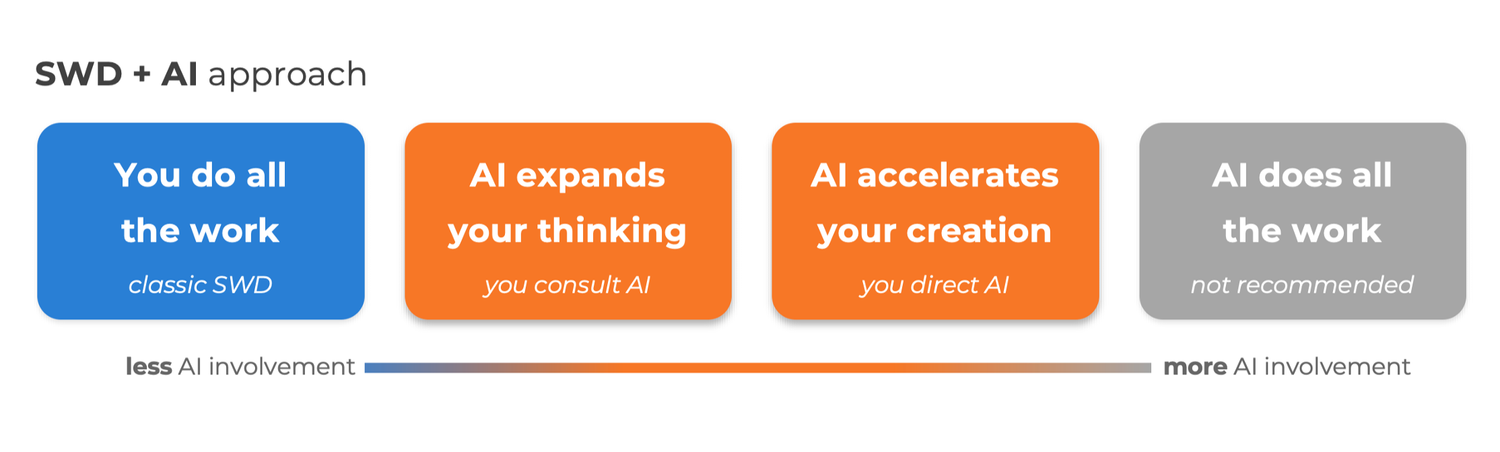
AI & Data Viz
Or, to make it simpler: Making charts with AI (as opposed doing it yourself with MS Excel). Good stuff here from the folks at Storytelling With Data: https://www.storytellingwithdata.com/ai-data-storytelling
Monday, September 7, 2026
485 Million Years!
Good WP article & PBS Terra video!

- The REAL STORY of Climate Skeptics New Favorite Graph
- Scientists have captured Earth’s climate over the last 485 million years. Here’s the surprising place we stand now.
What are the take-home messages? CO2 is the main climate driver and climate change is normal. Yep, but: the climate change we are measuring today is a) much faster than anything over the last 485 million years and b) caused by humans, not by nature.
Saturday, September 5, 2026
Lean & AI
Lean is the hip thing in math these days, especially in connection with AI. That's all I know, but here's more: ‘It is incredible’: How AI is transforming mathematics
Friday, September 4, 2026
Slop Tells & LLM Cliche Highlighter
Worried that your reports, slides, talks, etc. sound 'too AI' because you used too much AI to make them? Well, now you can use more AI tools to make your work sound 'less AI'. Great.
This reminds me a little of the good old EduBabble Generator & EduBabble Bingo.
Friday, August 28, 2026
August 2026 Glacier Collapse in Nepal
Here's what happend: a section of a glacier collapsed which trigged a landslide across a river valley that damed-up the river for a while before collapsing and triggering the flood. Yes, these events happen naturally, but it seems very likely that global warming and the associated destabiliztion of glaciers and permafrost 'loaded the dice' and increases the liklhood, magnitude, and intensity of such events.
Why do we need gen-eds?
Or, perhaps the better question is this: how many gen-ed classes should be required to get a Bachelor's degree? 10% of all classes? 25% of all classes? 33% of all classes? Trust me when I say this: nobody wants to take them, teach them, or pay for them.
Why science needs the huaminties more than ever (Nature, 25 June 2026) argues the usual: STEM fields, alone, cannot offer the ethical reasoning, historical context, and cultural connecctions that are required to be an informed and responsible citizen of the world. 'Hard' technical expertise is critical but has to be complemented by 'soft' human skills.
That's fine & I don't think anyone disagrees with that. But here are the practical questions:
- Do we really need a take an array of special classes that have nothing to do with our desired profession to get these 'soft' human skills? Or, could this be infused & embedded in classes that also offer pratical professional skills?
- Let's agree that we need special gen-ed classes: how many? Currently we basically force students to take about 1/3 of all their classses in the gen-ed curriculum - that seems too much to me.
Here's my proposal: create a mandatory Minor that all students need to take that consists of 6 classes or 18 credits: 1 science class with a lab, 1 math class, 1 writing class, and three more classes in the arts, humanities, and social sciences.
Tuesday, August 25, 2026
Hawaii & The Jetstream
Fun graphics, data, and map here: Every nonstop to Hawaii, and what the wind costs you
Obviously it takes longer to fly west than to fly east in the mid-latitudes because of the the prevailing winds & this website does a nice job of demonstrating this without any fancy animations.
Monday, August 24, 2026
SLR Map
Nothing new here, but a nice interface & an option for an image export - nice! The steps are 2 m, 10 m, 30 m, and 70 m - would be nice to offer more options such as 1/3/5 meters and/or specific ones, especially for the West Antarctic Ice Sheet. Explore here: Simulate Coastlines After Sea Level Rise
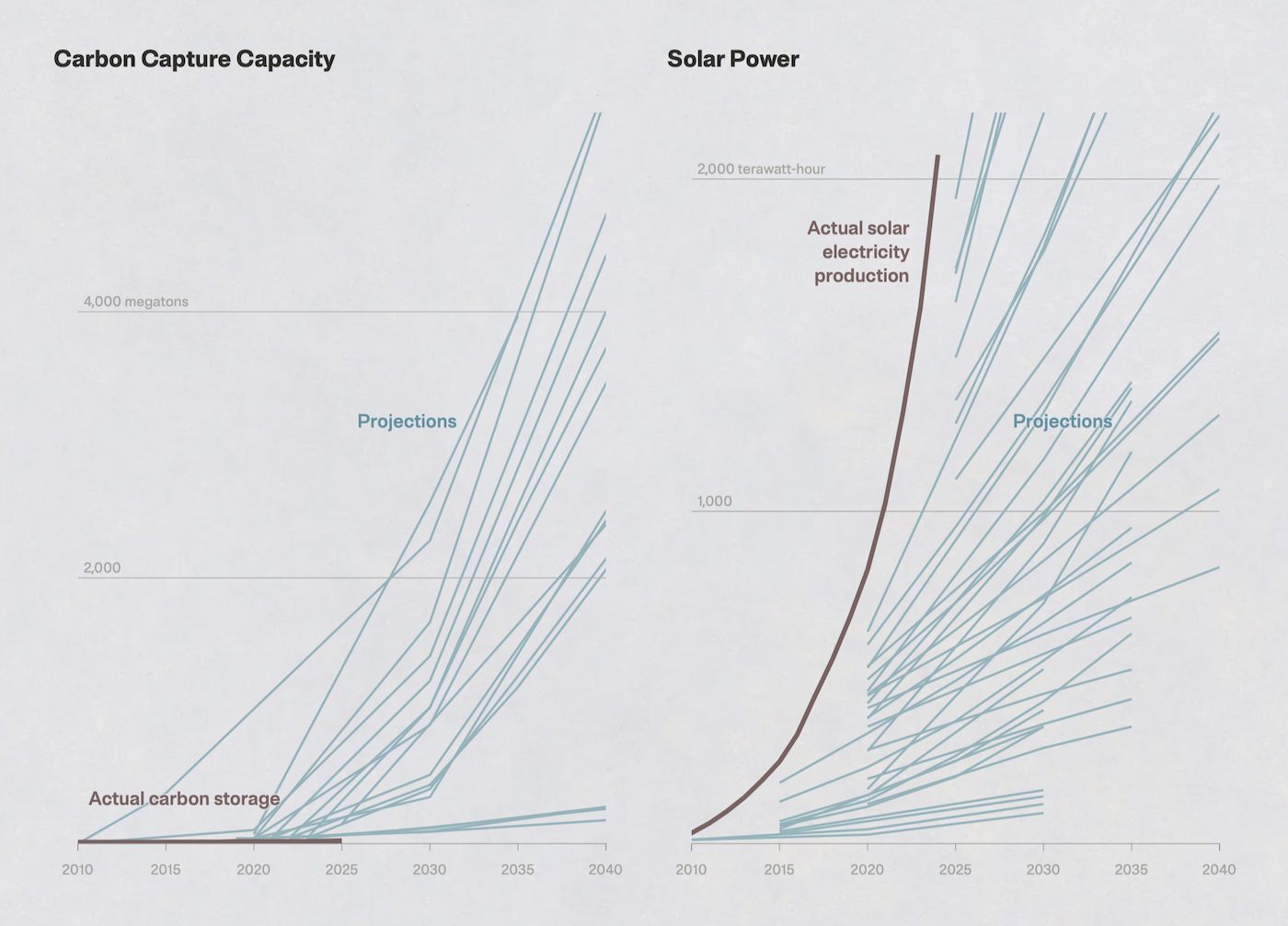
CCS will NOT work!
But, solar & wind will! More @ https://projects.propublica.org/why-carbon-capture-cant-solve-climate-change/. The chart below is from Flowing Data:
Sunday, August 23, 2026
3D Undergound
Who knew: there is a website / service called DrillerDB that compiles all US well logs (something like 23 million) and also offers a 3D underground visuzalization based on these well logs. It's a little glitchy and I'm not sure about the accurcay & consistency of these data, but it would match the known regional geology prety well I would assume:
Try it here: https://drillerdb.com/underground and read more about it on Maps Mania.
Tuesday, July 14, 2026
Flow Maps
Flow Maps are cool, but really tricky to actually design & make look good. Here are two good resources:
- Flow Maps (by Esri) shows some hacks in ArcGIS Pro & ArcGIS Online that can be used to make flow maps.
- Flow Mapping (by PennState) is a great overview & introduction.
Friday, July 3, 2026
National Parks: Crowds & Climate
This is a very cool analysis: what's the best time of the year to visit a given US national park if you want to balance crowds & weather? Sure, there are hardly any crowds in Glacier National Park in January, but you are in the middle of winter. Likewise, J-Tree is pretty empty in July, but can you deal with the heat?
Explore it all here: How to See the Most Popular US National Parks, Without the Crowds
An American Mosaic
Coool interactive web map by the NYT: An American Mosaic
There is an article to go along, but that's behind the NYT paywall.
Svalbard: Fossil Fuels, Geopolitics & Science
Good article here: Feeling a chill

Basically, Svalbard finds itself at the center 21st century geopolitics 'cloaked' as science between the USA, Europe, Russia, China, India. etc.

Thursday, July 2, 2026
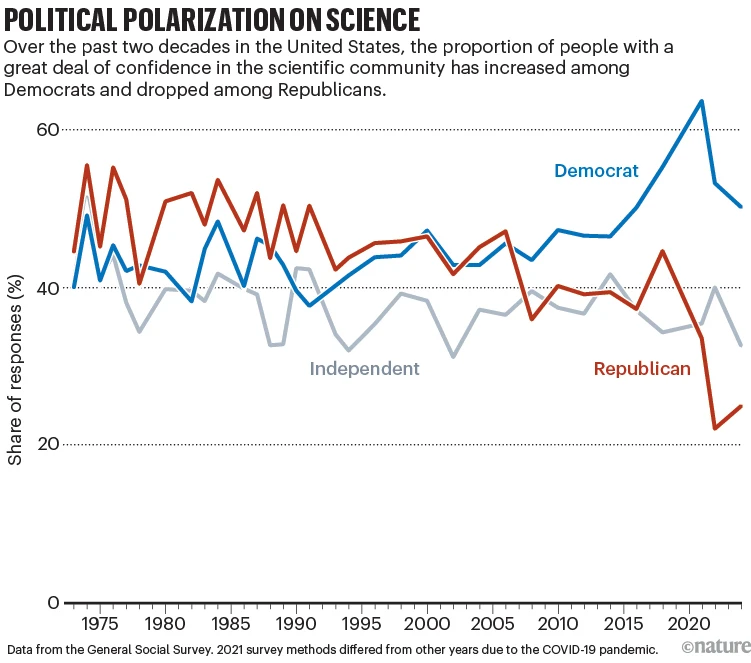
Have people stopped trusting science? The data tell a surprising story
Have people stopped trusting science? The data tell a surprising story (Nature, 1 July 2026) shows something that I did not expect - see figure below.
- The about 20 percent drop for Republicans beginning around 2018 makes sense: Thanks Donald & Fox News!
- But, what causes the about 10 percent drop for Democrats starting around 2020 & the about 5 percent drop for Independents starting a few years later? Is that just a methods artifact due to COVID?
Tuesday, June 30, 2026
Urban Plannning & Washington DC
Great scrolly map from the NYT for our history & urban planning nerds: Washington Has Been Carefully Planned for Two Centuries
Friday, June 26, 2026
The 3-30-300 'Rule'
Cool stuff over on Maps Mania: The 3-30-300 Rule for urban trees & interactive mapping tool. Read more about this rule or goal @ https://www.330300rule.com/.
Wednesday, June 24, 2026

True Orthos vs Trad Orthos & ArcGIS Reality
First, what is ArcGIS Reality?

I'm not entirely sure, here's what Esri says: ArcGIS Reality is a suite of photogrammetry software products designed to enable reality capture workflows for sites, cities, and countries.
One main feature seems to be the abilaity to create & use so-capped True Orthophotos as opposed to Traditional Orthophotos.
- True Orthophotos vs. Traditional Orthophotos: Why do pixels matter in the age of AI?
- The Different Types of Ortho Images Created in ArcGIS
The animated GIF below demonsrates the main difference between true orthos & trad orthos.

Climate.us
It is scary that we have come to this: Climate.us is the 'new' = reliable version of Climate.gov. More here: https://ncse.ngo/climateus-launches.
Here's the short version: Climate.us "launched the full version of its new independent, nonprofit climate information website, creating a public-backed home for trusted climate science at a time when access to federal climate resources has become increasingly vulnerable to disruption," according to a June 22, 2026 press release. The launch was covered by The New York Times (July 23, 2026), which described Climate.us as "an effort by former staff members at the National Oceanic and Atmospheric Administration to present climate science previously housed at climate.gov, including data, reports, articles, and congressionally mandated national climate assessments."
Friday, June 19, 2026
AI & Data Viz
How can we use AI as a collaborator for data viz? The folks over at SWD have a nice selection of videos and practical tutorials on how to collaborate with AI in the data viz / data storytelling process: https://www.storytellingwithdata.com/ai-data-storytelling
Jerry's Map
Read more about it here: https://www.jerrysmap.com/the-map
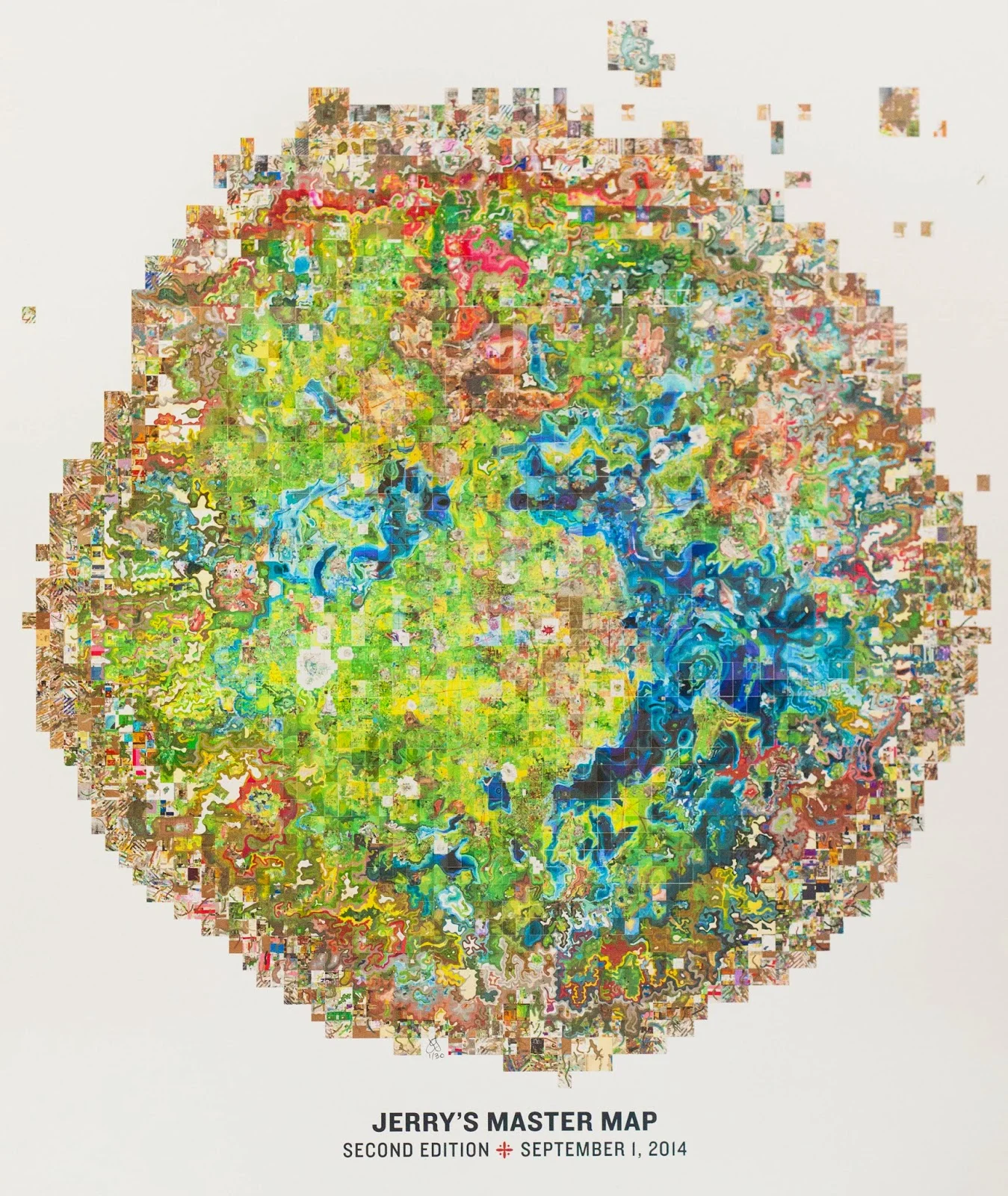
The map is an imaginary city comprised of over 4,000 8 x 10 inch panels. The static image is below and here's an interactive version: https://marcmajcher.github.io/jerrysmap/
Thursday, June 18, 2026
Global Warming = Warmer Troposphere & Colder Stratosphere
We already know that from a) basics physics, b) climate models, and c) observations. Here's the short version: In the troposphere, the energy received at the Earth's surface is dispersed by convection, storms, and wind = weather. In contrast, there is no 'weather' in the stratosphere - there is just no enough air up there to create convection and air pressure differences.
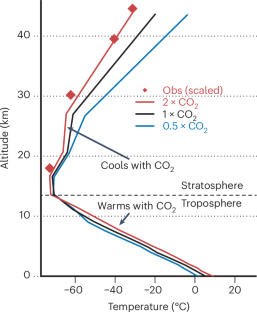
Instead, the temperature of the stratosphere & its vertical gradient is determined by a) UV radiation absorption by ozone = warming and infrared radiation emission from the CO2.
Now it gets interesting:
- More CO2 in the troposphere means more trapping of heat near the surfacce & thus warming.
- More CO2 in the stratosphere does the opposite: it emits more radition into space & thus causes cooling.
Furthermore, this cooling effect of CO2 in the stratosphere increases with altitude from basically zero at the tropopause to more and more as you go higher & higher. Why is that? Well, turns out that the ozone layer is relatively low in the stratosphere & its effect dimishes the higher you go in the stratosphere while at the same time the influence of CO2 gets stronger.
Yes, it gets warmer in the stratosphere due to the presence of ozone. This is not impacted by global warming. Global warming does mean that there is more CO2 in the stratosphere & that overall cools the stratosphere = shifts the vertical gradient to the left.
All that is basic physics!
Not something weird created by climate models!
Wednesday, June 17, 2026
The Reuters Climate Monitor
Pretty cool data viz: The Reuters Climate Monitor
The interactive globe is cool, but the chart below is more interesting & shows just how much the New Normal is above the Old Normal.
Friday, June 12, 2026
The AMOC!
Excellent arcticle & visuals about the AMOC: Shifting currents - After decades of warnings, new data suggest the Atlantic’s vital circulation may withstand climate warming better than feared
Also available as a PDF here.
Thursday, June 11, 2026
Ozone Pollution From Space
Air Pollution’s Daily Pulse Over the Northeast is a cool example of how we can now monitor air pollutions from space & how it changes over the course of the day! You start with the NO2 plumes from car exhaust & how they dissipate over the course of the day. Then you can look at the plumes of ground-level ozone created from the NO2 & their spatial patterns which are impacted by wind patters.
Wednesday, June 3, 2026
Saturday, May 30, 2026
Recent Land Use Changes: USA
This is interesting: A Shift in What’s Shaping U.S. Landscapes

The three main types of land use changes are urban sprawl, logging, and agriculture & here the New England has remained pretty stable over the last 40+ years or so. Why? The main land use changes had already occurred by 1988.
Tuesday, May 12, 2026
Ellis: Your Trusted & Experienced Teacher Colleague
This is pretty cool: imagine you have 24/7/365 access to a very experienced colleague who is also up-to-date with the latest research and best-practices when it comes to learning differences and mental health. Well, Ellis is supposed to be just that & (of course) is powered by AI.
- Ellis: Your On-Demand Classroom Companion
- Ellis Product Walkthrough 2026 (YouTube)
- https://www.askellis.org/
It's difficult to imagine that this could work...but a) it may be better than nothing and could b) be useful in Higher Education where the teachers (= professors) usually have little or no training or experience with such issues.
Saturday, May 9, 2026
Ethics in GIS
Interesting read: Enlisting AI to Mainstream Ethics in Spatial Data Science Education
Here's a new-to-me term: Ethics Across the Curriculum or EAC - the idea that ethics should be woven throught the entire curriculum from beginning to end. Here are some resources:
- The Guide to the Geographic Approach contains 15 open-access modules & some of those include ethical issues and questions.
- Now there is GISEthics.org and its collectiom of 21 case studies.
What to do in-practice? Three things: 1) use a formal case study analysis, 2) use a disucssion forum prompt, and 3) include an ethics-related learning objective. How you may ask? Try the AI-based Ethics Case Study and Discussion Prompt Creator and create yourself a case study that aligns with your course content, a customized discussion forum prompt. and even your learning objective for the course syllabus.
Here's a complete case study from Claudi.ai: When the Map Has a Memory
Saturday, May 2, 2026
ArcGIS Story Maps
A compliation of useful resources related to Esri / ArcGIS Story Maps / ArcGIS Online
The Big Picture
- HydroSHEDS 2.0 is now in the Living Atlas - looks like a great data set!
- The World Imagery Wayback is awesome for science & research!
Friday, May 1, 2026
Your Name in Landsat!
Silly, but fun: Your Name in Landsat
Maybe even a good way to explore landforms in a Physical Geography class!
Saturday, April 25, 2026
Thursday, April 23, 2026
ChatGPT Images 2.0
I have not tested it, but apparently ChatGPT Images 2.0 can basically create a complete research poster for you. Not sure how this would work in-practice for anything that includes 'original' research, but it should work fine for the classic student literature-review poster.
Saturday, April 18, 2026
Social Media For AI Agents
This is brilliant & scary at the same time: imagine AI agents 'chatting' with each other via social media using a Reddit-style interface. Moltbook seems to be that.
Then there is Agent4Science = a social network for AI scientists. Read more about it here.
Now we need more AIs to analyze these interactions & see if we can learn if/how AI agents change over time. This will also generate vast amounts of new potential training data for the AIs themselves much the same way that human Reddit & Facebook threads are used as AI training data.
Tuesday, April 14, 2026
Urban AI
Interesting article: Datacenters as core infrastructure of urban AI
He basically argues that the so-called 'cloud' comes with serious environmental impacts and externalities. Sure, we all want smart cities (aka data-driven urbanism) managed by Urban AIand love to talk about the cool edge-computing devices, but there is a hidden infrastructure (often in the suburbs & beyond) that make all this possible and that raises serious questions related to ownership. governance, and operation.
Here, physical distance or proximity often becomes irrelevant and with that many of our existing regulatory system fail.
Cloud providers want a) cheap electricity, b) low taxes, c) lax regulations, and d) proximity to high-speed connecticity. Thus, clusters develop along metropolitan corridors and once again regions farther away are left behind. Furthermore, AI providers obviously prefer to serve profitable sectors of the economy as opposed to common good public functions.
For cities this also means an increasing dependence on a small number of vendors who control the infrastructure & access to it. We are 'locked-into' whatever we choose.
In summary: Urban AI or any AI for that matter means infrastructure & calling it 'the cloud' hides the fact that this infrastructure and access to it creates power & privilege.
Saturday, April 11, 2026
Outdoor Recreation Data
Great data, great data viz, great interactive maps, and all the data are free to download as CSV files: Outdoor Recreation Data
Thursday, April 9, 2026
Sunday, April 5, 2026
Kathrine Hayhoe: Christians, Creation, and Climate Change
Good stuff especially towards the end: Solution aversion & talk about it!
Friday, April 3, 2026
The Institute and Faculty of Actuaries
The Institute and Faculty of Actuaries (or IFoA) produces excellent synthesis & reports related to climate change. Here's the latest one: Parasol Lost: Recovery plan needed
Remember, these are actuaries = experts in the measurement and management of risk and uncertainty. More about the report in the video below.
Wednesday, April 1, 2026
Cartokit
Cartokit is a direct manipulation programming environment for interactive cartography on the web. Vey cool! See more over on GitHub: https://github.com/parkerziegler/cartokit
Thursday, March 26, 2026
State of the Global Climate 2025
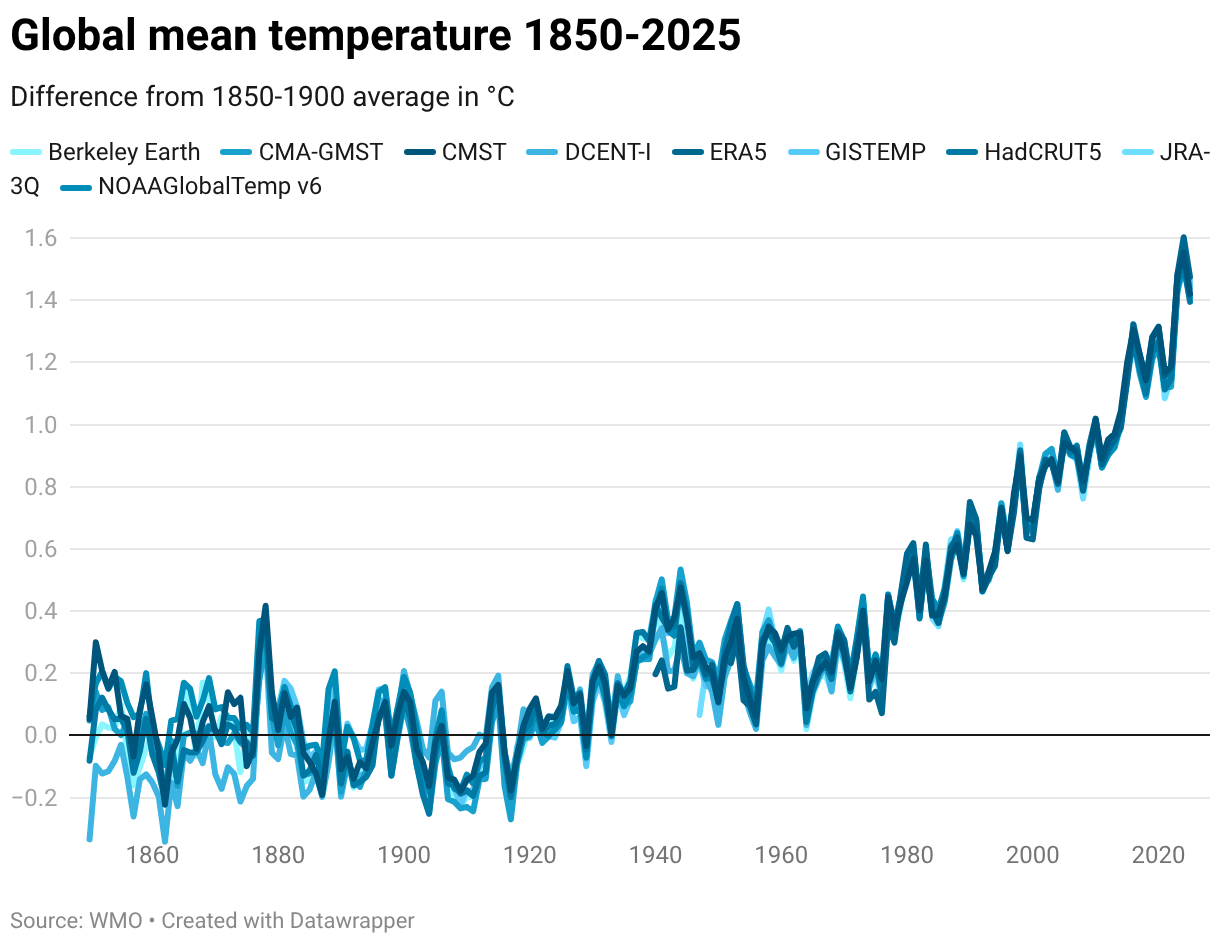
The State of the Global Climate 2025 by the WMO is out and confirms once again what we have already known for decades. This one comes with a cool ArcGIS Dashboard of the 2025 Extreme Events, a great tool for presenting such data.
The highlights: The last 11 years (i.e. 2015 - 2025) have been the hottest on record with 2024 being the hottest & 2025 the 2nd hottest.
Tuesday, March 24, 2026
The Dance of the Continents
Dance of the continents is a very nice Esri Story Map showing the interplay of plate tectonics and evolution over the last 600 million years. I especially like the first section where you can step backwards in time to see the (current) continents come together first as Pangea and then again as Rodinia.
Wednesday, March 18, 2026
AI & Jobs: Vulnerability
Saw this on Flowing Data: Jobs vulnerable to AI. This links to Measuring US workers’ capacity to adapt to AI-driven job displacement where the authors 'mapped' job vulnerability as a function of a) exposure andb) adaptability.

Tuesday, March 3, 2026
Defossilization
That was a new term for me: defossilization. We will still very much need carbon-based compounds (even after we transition to 100 percent sustainable energy) for manfacturing of plastics, detergents, medicines, and more.
Okay, so we still have plenty of oil around...so why not use the oil for that? We should have plenty 'excess' capacity in the oil fields! Plan is a CO2-to-methanol process powered by solar energy and then the methanol is converted to olefines (e.g. ethylene & propylene) which are petrochemicals that can be used to manufacture plastics and more.
Sunday, March 1, 2026
Bill McKibben
Bill McKibben is always a worthy read & watch:
Here's his main take from the article:
The 'old' heart of Christianity was lover & concern for other as lived by Jesus. The 'new' heart of Christianity is personal salvation and that required them to 're-make' Jesus into some else entirely.
Back in the late 1950s, some 52 percent of Americans were part of the so-called mainline denominations (e.g. Methodist, Lutherans, Congregationalists, Episcopalians, etc.) and about 33 percent were Catholics. Modern Christanity is instead dominated by megachurches, TV ministries, and right-wing evangelicals who are the MAGA core.
Mainline Protestantism surrenderd their version of Jesus to this new toxic form of Christianity without a fight & we see the same thing today with America: we are surrendering our version of America (as imperfect as it is) to MAGA without much of a fight.
Saturday, February 21, 2026
Saturday, February 7, 2026
Friday, February 6, 2026
Data Center Infrastructure in the United States (2025)
The map of Data Center Infrastructure in the United States, 2025 is just that: a classic 'static' map.

Thursday, February 5, 2026

Saturday, January 31, 2026
Food Deserts / Grocery Deserts
Great web map: Mapping Food Deserts and Grocery Store Consolidation
Now...if they would only offer a way to download the data!
Thursday, January 29, 2026
The Oldest Globe
As seen on Maps Mania: the world’s oldest surviving terrestrial globe from 1492 that obivously does not yet include the Americas!


Sunday, January 25, 2026
Letters From The Earth
Cool project & something that I have been thinking about: sure, we have plenty of data & facts, but now can those be made a) meaningful to b) promote reasonable actions?
Letters From The Earth uses AI to translate 'boring' data into expressive text = If the Earth could describe its own day using the same signals we collect about it, what would it say?
Their Core Hypothesis: Data contains expressive qualities beyond analytics, and AI can translate those qualities into new modalities that invite more people to participate in understanding and meaning.

Thursday, January 8, 2026
Cloud Optimized Data Formats
Cloud Optimized Data Formats is about as boring as it gets...but not when they are explained in a fun zine-comic book! Here's the link: Optimizing Geospatial for the Cloud
Brilliant!
Brilliant has been around for a while, but the free version always has been a little limited. But there is an Education Version for K-12 as well that offer free premium access - might be interesting!
Napkin.ai
From the website: "Napkin turns your text into visuals so sharing your ideas is quick and effective." Sounds interesting and there is a free version.
Try it here: https://www.napkin.ai/
Thursday, January 1, 2026
EMBER
EMBER offers great data and nice visual data explorers for all kinds of domestic and international energt data. The data are available for download as CSVs and the interactive charts as PNGs and the data for each chart as CSVs as well = great!
.png)
Subscribe to:
Posts (Atom)