Showing posts with label Energy. Show all posts
Showing posts with label Energy. Show all posts
Friday, June 19, 2026

Wednesday, June 3, 2026
Tuesday, April 14, 2026
Urban AI
Interesting article: Datacenters as core infrastructure of urban AI
He basically argues that the so-called 'cloud' comes with serious environmental impacts and externalities. Sure, we all want smart cities (aka data-driven urbanism) managed by Urban AIand love to talk about the cool edge-computing devices, but there is a hidden infrastructure (often in the suburbs & beyond) that make all this possible and that raises serious questions related to ownership. governance, and operation.
Here, physical distance or proximity often becomes irrelevant and with that many of our existing regulatory system fail.
Cloud providers want a) cheap electricity, b) low taxes, c) lax regulations, and d) proximity to high-speed connecticity. Thus, clusters develop along metropolitan corridors and once again regions farther away are left behind. Furthermore, AI providers obviously prefer to serve profitable sectors of the economy as opposed to common good public functions.
For cities this also means an increasing dependence on a small number of vendors who control the infrastructure & access to it. We are 'locked-into' whatever we choose.
In summary: Urban AI or any AI for that matter means infrastructure & calling it 'the cloud' hides the fact that this infrastructure and access to it creates power & privilege.
Thursday, April 9, 2026
Friday, April 3, 2026
The Institute and Faculty of Actuaries
The Institute and Faculty of Actuaries (or IFoA) produces excellent synthesis & reports related to climate change. Here's the latest one: Parasol Lost: Recovery plan needed
Remember, these are actuaries = experts in the measurement and management of risk and uncertainty. More about the report in the video below.
Tuesday, March 3, 2026
Defossilization
That was a new term for me: defossilization. We will still very much need carbon-based compounds (even after we transition to 100 percent sustainable energy) for manfacturing of plastics, detergents, medicines, and more.
Okay, so we still have plenty of oil around...so why not use the oil for that? We should have plenty 'excess' capacity in the oil fields! Plan is a CO2-to-methanol process powered by solar energy and then the methanol is converted to olefines (e.g. ethylene & propylene) which are petrochemicals that can be used to manufacture plastics and more.
Saturday, February 21, 2026
Friday, February 6, 2026
Data Center Infrastructure in the United States (2025)
The map of Data Center Infrastructure in the United States, 2025 is just that: a classic 'static' map.

Thursday, January 1, 2026
EMBER
EMBER offers great data and nice visual data explorers for all kinds of domestic and international energt data. The data are available for download as CSVs and the interactive charts as PNGs and the data for each chart as CSVs as well = great!
.png)
Thursday, December 4, 2025
Losing the Climate Info Wars?
Good stuff here: Losing the Climate Info Wars?
"The strategy is not subtle, a recent study found. Climate skeptics present their position as “projecting rationality, authority, and masculine self-control” while those who acknowledge global warming “are depicted through emotionally charged, feminized, and irrational imagery,” and labeled “alarmists” who propose radical solutions.
Political campaigns deploy the same playbook. Republicans frequently claimed the Biden administration was trying to “emasculate” American drivers by forcing them into electric vehicles. Lee Zeldin, Mr. Trump’s Environmental Protection Agency administrator, has labeled climate change a “religion” instead of what it is: a matter of physics.
Taylor Rogers, a White House spokeswoman, said that Mr. Trump was pursuing “energy addition, not energy transition.”
“The President has set a strong example for the rest of the world by reversing course on the Green Energy Scam and unleashing our natural resources, like beautiful, clean coal and natural gas, to strengthen our grid stability and lower energy costs,” she said, citing arguments that many economists dispute."
Tuesday, December 2, 2025
No More GDP!
Great article in Nature by Constanza et al.: Beyond growth — why we need to agree on an alternative to GDP now
Here's the summary: GDP was never designed as a metric for human well-being. It kind of worked as a proxy for that for a couple of decades after WWII, but no more. Using GDP assumes substitutability between labor, technology, and natural resources in the context of production. But this obviously ignores ecological limits or planetary boundaries, or, in other words: it decouples economic activity from natural resource use.
We need instead to adopt a universal goal: sustainabilty & inclusive well-being. Not sure why inclusive well-being is separated from sustainabilty here, but ok. The question then is how do we a) measure that and b) how do we aggreate our metrics into some kind of index or proxy? Here are some of the metrics: Well-being components: these 19 core factors are common to most beyond-GDP indicators.
Human
- Life satisfaction
- Health
- Life expectancy at birth
- Education
Social
- Crime
- Civic engagement
- Governance
- Income equality
- Gender equality
Built
- Housing
- Infrastructure
- Financial security
- Employment
- Per capita consumption
- Business health
Natural
- Natural capital
- Water quality
- Air quality
- Greenhouse-gas emissions
Sounds a lot like donut economics to me!
The Cost Of Living
Excellent data set & web map from the Economic Policy Institute: The Family Budget Map. This map shows (by county) the cost-of-living for a 'normal' two-parent, two-child family broken down into housing, food, child care, transportation, health care, taxes, and other necessities.
Even better: the data are accessible as MS Excel!
Tuesday, November 11, 2025
Bills Gate's Climate Memo
So, everybody is going crazy over Bill Gate's recent 'memo': A warmer world will hurt this group more than any other
Read the details yourself, but Gates basically presents the classic mitigation vs adaptation strawman argument that goes something like this: "For most people, the greatest problems are poverty and disease, not climate change and therefore we should focus on those, not climate change."
Ok, Bill: let's talk:
- That's just a false dicotomy - we can & should focus on both.
- Climate change is a threat and harm amplifier.
- The greatest impacts of climate change today & in the future will happen in the poorest countries.
- A 2.5 - 3 C warmer world will be radiacally different from our world today.
Mike Mann has a nice World View piece in Nature: Bill Gates’s climate comments are a dangerous distraction. Mike starts with the classic Stephen Schneider statement: when it comes to climate change, the "end of the world" and "good for you" are the "two lowest-probability outcomes". Read the rest!
Predictably, climate deniers jumped on this & claimed that Bill now supports them in rejecting the climate change hoax: “I (WE) just won the war on the climate change hoax.Bill Gates has finally admitted that he was completely WRONG on the issue. It took courage to do so, and for that we are all grateful. MAGA!!!”
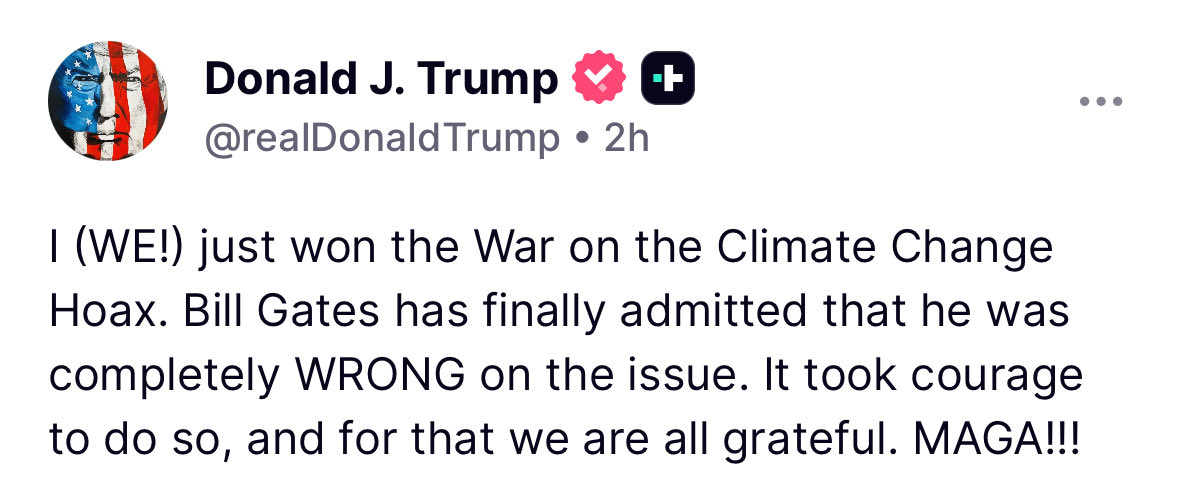
The questions is: why...why spend your time & resources on this 'memo'?
Tuesday, September 30, 2025
Are Rooftop Solar Panels the Solution to America's ...
This looks great, but unfortunately behind the NYT paywall: https://www.nytimes.com/interactive/2025/09/27/business/energy-environment/rooftop-solar-panels.html
Friday, September 19, 2025
The Electrotech Revolution
The Electrotech Revolution is a good read & a great slide deck - here are the three take-home bullet points:
- Physics: Electrotech makes the energy system more efficient. Electrotech is around three times more efficient than fossil fuel systems, which waste two-thirds of primary energy inputs (380 exajoules) as heat at a cost of $5 trillion every year. Solar and electrification enable us to harness the power of the sun, which gives access to 100 times as much energy as fossil fuels.
- Economics: Electrotech gets cheaper as it scales. Fossil fuel commodities get more expensive as extraction continues, and their prices are elevated by major producers controlling the supply. Electrotech is manufactured and modular, resulting in clear technology learning curves, with costs falling by around 20% every time deployment doubles. Electotech is already capturing two-thirds of global energy investment and is responsible for all the expected growth in energy jobs. Electrotech contributed 10% of global GDP growth in 2023, including 22% in China, 5% in India, 30% in the EU and 7% in the US.
- Geopolitics: Electrotech enhances independence and security. 80% of the world lives in fossil fuel importing countries, with over 50 countries importing more than half their primary energy as fossil fuels. In contrast, 92% of countries have renewables potential over ten times their current demand. Replacing imported fossil fuels using three key levers—EVs, heat pumps and renewables—can cut net fossil fuel imports by 70%, saving $1.3 trillion globally each year. Once electrotech is bought, it lasts for decades, providing insulation from the vagaries of global pricing. When fossil flows stop, the economy stops. When electrotech flows stop, only growth is at risk.

Sunday, September 14, 2025
Charlie Kirk: Climate Denial & More
In case you missed it: find Charlie Kirk quotes @ https://zeteo.com/p/charlie-kirk-in-his-own-words.
Saturday, September 13, 2025
The Nature-Positive Movement
This looks like a great book: Becoming Nature Positive: Transitioning to a Safe and Just Future and here's the review in Nature: How to build nature back better — read this manual
The idea is that it is insufficient to just reduce environmental harm or become sustainable, but rather to regenerate nature in an active way = become nature-positive. This would be the opposite to the standare greenwashing that we see all over.
Here's an interesting angle mentioned in the review:
- Purpose-led businesses (e.g. Patagonia, etc.) can pursue ambitious goals & lead by example.
- Smaller companies can be agile and influence their local communities.
- Large companies have a) the resources and b) the scale throughout their entire supply that even small improvements can have a large aggregate impact.
Related: Rengerative Agriculture. I'm not a farmer, but these all seems like no-brainers: plant cover crops, rotating crops, reduc tilling, and integrate trees all to a) prevent soil erosion and b) improve the soil. Read more about here: A revolution is sweeping Europe’s farms: can it save agriculture?
Sunday, June 29, 2025
Ai & Energy Use
This is a great multimedia story map interactive about AI & Energy Use from the MIT Technology Review: We did the math on AI’s energy footprint. Here’s the story you haven’t heard.
Tuesday, May 20, 2025
USA: Counties & Population
Very cool animated map of the basic problem of human geography in the USA and anywhere: most people live in small & densely-populated area while most of the country is pretty much empty.
Tuesday, May 6, 2025
The Climate Justice Instructional Toolkit (CJIT)
The Climate Justice Instructional Toolkit (CJIT) (by MIT) offers a wide-range of climate justice adaptable teaching modules, a starter guide for teaching climate justice, resources for students, and climate justice data sets that can serve as supportive tools to enhance professor and instructor teaching content and approaches.
Subscribe to:
Posts (Atom)