Tuesday, July 7, 2015

Saturday, July 4, 2015
Time-Lapse Mining
The concept is simple: let's crowd-source pictures of popular landmarks and stitch them together in-time to create a time-lapse video. The details are of course much more complex and explained in Time-lapse Mining from Internet Photos by Ricardo Martin-Brualla and others.
A 3D Body Scanner
This is cool: all you need is 50 Raspberry Pis, 50 digital cameras, a bunch of PVC piping, and some other stuff and you can build yourself a 3D scanner: A very low-cost 3D scanning system for whole-body imaging
Friday, July 3, 2015
Social Media for Scientists
Facebook, Twitter, Google+, Instagram, SnapChat, WhatsApp, Pinterest, Myspace (gasp!) - it is not easy to choose your social media identities! A similar problem nowadays exists for scientists with at least three competing academic social networks: ResearchGate, Academia.edu, and Mendeley. The article Scientists and the social network (Nature, 14 August 2014) explores the issue.


Thursday, July 2, 2015
GradeCraft
GradeCraft is an LMS to support 'gameful' courses - read more about it over at the Wired Campus. The basic idea is to mimic a video game where mistakes don't come with any real consequences - you can simply start over and repeat the level. In contrast, most college courses are structured around several high-stakes tests and/or papers and any mistakes on those typically have a real negative impact on the final grade.
The Planetary Dashboard
This has been around for a while - but updated as of January 2015: The Planetary Dashboard showing the Great Acceleration (since 1950). What I like about this is that you can access this study in a variety of ways: a) the aforelinked website, b) the peer-reviewed paper, c) the detailed slide show, and d) the underlying data (as a MS Excel table).


Wednesday, July 1, 2015
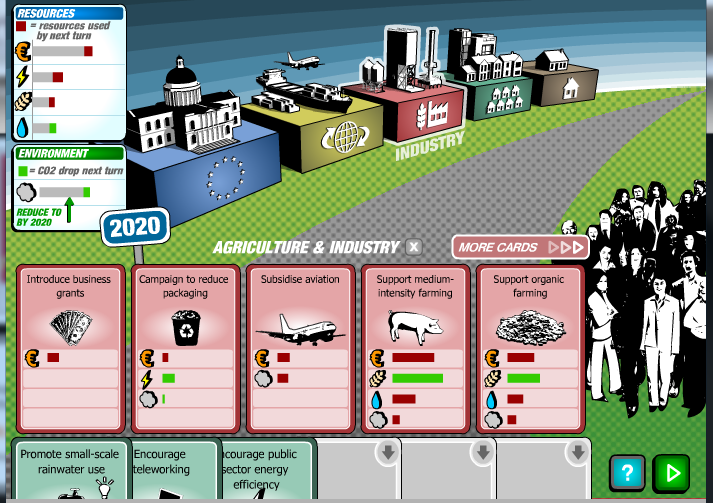
The BBC Climate Challenge
If learning about climate policy options and consequences as you play a game sounds good to you: try the BBC Climate Challenge game or first read the review by Kate Heffernan on the NCSE blog.
Personally I always feel a bit ambivalent about using educational games in the context of serious issues such as climate change - framing it as a game to me sends the wrong message and trivializes the very real consequences of climate change. Yet I also realize that games can be a good way to explore complex issues in a way that is structured, fun, and engaging.
Personally I always feel a bit ambivalent about using educational games in the context of serious issues such as climate change - framing it as a game to me sends the wrong message and trivializes the very real consequences of climate change. Yet I also realize that games can be a good way to explore complex issues in a way that is structured, fun, and engaging.
 |
| http://ncse.com/files/bbc2.0_0.png |
Subscribe to:
Posts (Atom)